Modules
.svg)
When we want to improve our explanation of a research question, it can be helpful to take it apart and examine our question piece by piece. Several frameworks exist that are specific to certain types of research. Here, we take a generalizable approach, using Who, What, Why, and How to break things down.
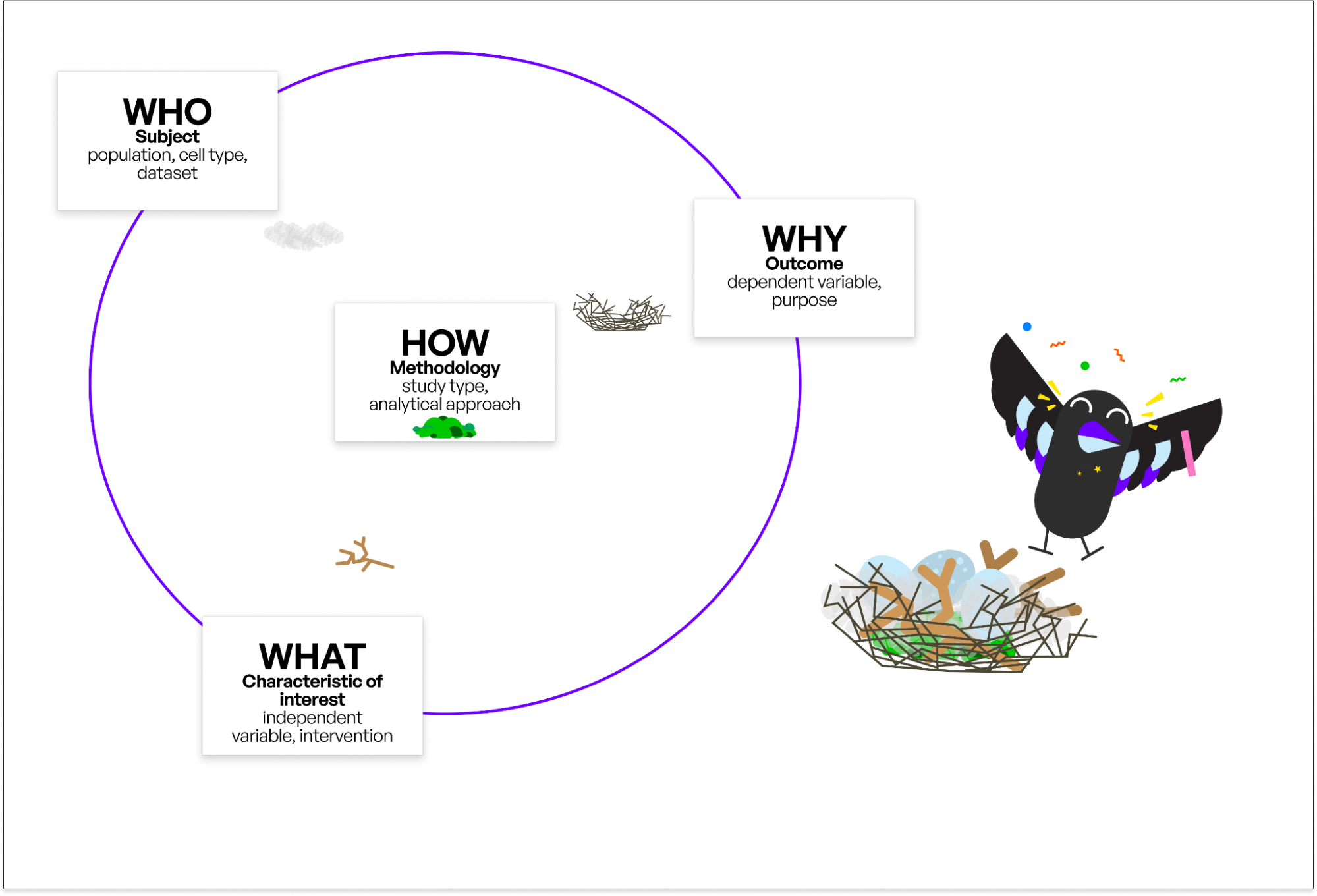
The “Who” of a research question describes the subject. Depending on the study, this may be a population, a cell type, or even a dataset.
The “What” describes the characteristic(s) of interest and will vary tremendously depending on study design. If your study has an intervention or an independent variable, this belongs in your “What.”
The “Why” is the outcome of your study. This category may include both proximate outcomes – often a dependent variable – as well as the ultimate purpose.
A well-defined “Who,” “What,” and “Why” should all be optimized to relate to each other. Together, they dictate the “How”: the methodology, study type, and analytical approach of your study.
CALLOUT: Is something missing? Were you expecting “Where” and “When” to make an appearance? These features are certainly important in some studies, but they best describe the Who, What, Why, or How when they matter. For example, the “Who” might be specified by its location, or the “Why” might be specific to a time window.

.svg)
.svg)
When working with Who, What, Why, and How, it is important to keep a clear goal in mind. Our goal is to apply this framework as a tool to elaborate a research question, separating the question into components to make that process easier. Our aim is not “correct” classification of each element! With our examples as a guide, YOU can decide on the most useful ways to interpret each category for your own study.
As a process, we suggest the following:
- Break down your question into parts.
- Ask questions about each part.
- Add answers to improve the elaboration of your question.
- Repeat!
CALLOUT: Evaluate lightly for now. You might also find yourself evaluating the quality of the idea during this phase. This is fine, and you might want to write some notes down for later. At this stage, however, our primary concern is improving the explanation of the idea. We will get to evaluating the idea itself in the next lesson!
You’ve finished the Unit
Your feedback helps us to improve this and other units. Please use the tool below to share your thoughts.
We’ve collected a list of all sorts of rigor & reproducibility related tools along with links to relevant landing pages, notes as to whether a given tool is free and open source, and the specific part of the research process for which they might prove most useful. We even provide you with quick 10 minute exercises designed to give you an idea of how you make appropriate use of each tool! Check them out and spread the word, or submit tools we missed!
Link.
This is an index of various communities that serve to highlight tools, disseminate news, facilitate connection and guidance, and nurture the next generation of rigor champions. They empower, inform, and act as agents of (much needed) change — so be sure to join the discussion and do your part for rigor!
Link.
In order to ensure that the rigor community remains connected, self-identifying rigor champions are welcome to register with us to be listed in this directory and indicate their career stage, area of expertise, and open-ness to contact.
Link.